How to Start Investing in the Stock Market
Ready to grow your wealth but not sure where to begin? This complete beginner's guide walks you through everything you need to start investing in the stock market today — from opening your first account to choosing your first investment.

Building wealth through the stock market is one of the most reliable ways Americans have created financial security over the past century. Yet millions of people delay starting — often because they believe investing is complicated, risky, or reserved for the wealthy. None of that is true. With the right foundation, anyone can begin investing and let their money work harder than a paycheck alone ever could.
This guide will take you from zero to your first investment. You will learn why time in the market beats timing the market, how to open a brokerage account, which types of investments make sense for beginners, and what pitfalls to avoid along the way.
Table of Contents
- Why You Should Start Investing Today
- How the Stock Market Works
- Opening Your First Brokerage Account
- Choosing Your First Investments
- Understanding Risk and Return
- Common Beginner Mistakes to Avoid
- Your 30-Day Action Plan
Why You Should Start Investing Today
The single most powerful force in personal finance is time. Every year you delay investing is a year of compound growth you can never recover. Let that sink in: it is not about how much you invest — it is about how long your money has to grow.
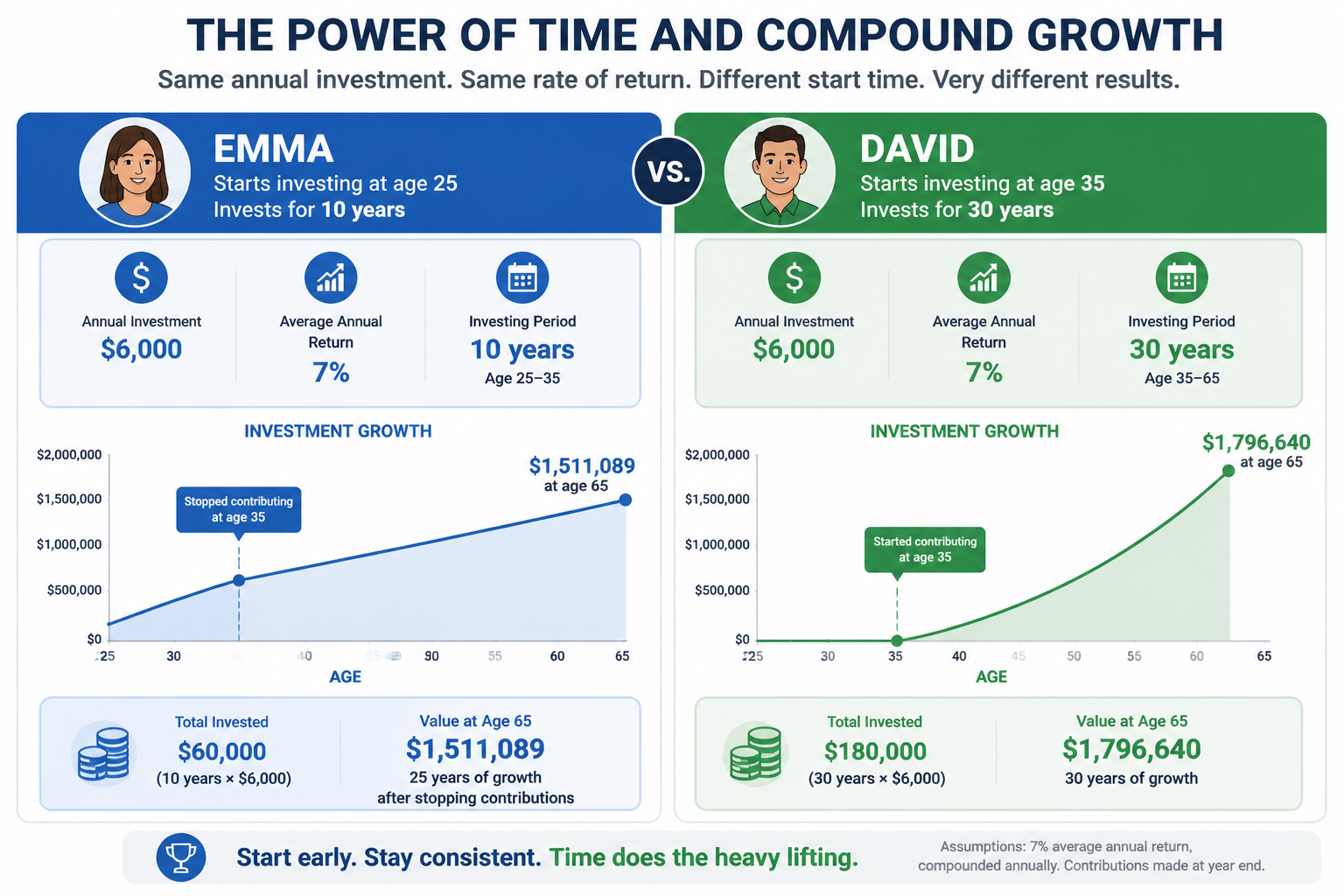
Here is a concrete example. Two investors both target retirement at age 65:
- Emma starts at 25. She invests $300 per month for just 10 years, then stops entirely. Total contributed: $36,000.
- David starts at 35. He invests $300 per month for 30 straight years. Total contributed: $108,000.
At a historical average annual return of 8%, Emma's account grows to approximately $349,000 by age 65. David's account reaches about $408,000 — but he invested three times as much money. Emma nearly matched him by starting a decade earlier. That is the compounding advantage in action.
Beyond growth, there is a cost to not investing. Inflation has historically averaged about 3% per year in the United States. A savings account paying 0.5% interest is effectively losing purchasing power every year. The money sitting in your checking account right now is quietly shrinking in real value. The stock market, by contrast, has returned an average of roughly 10% per year over the past 100 years — about 7% after inflation. Over long periods, that difference is staggering.
You do not need a large sum to begin. Many brokers allow you to open an account with $0 and start buying fractional shares for as little as $1. The barrier to entry has never been lower.
How the Stock Market Works
What Is a Stock?
A stock — also called a share or equity — represents a small ownership stake in a publicly traded company. When you buy one share of Apple, you literally own a tiny piece of Apple Inc. As the company earns profits and grows, the value of your ownership stake rises. Some companies also pay dividends: regular cash payments distributed to shareholders from company profits, providing income on top of price appreciation.
Companies issue stock to raise money for expansion, research, or paying off debt. Investors buy stock hoping the company will become more valuable over time, which drives the share price higher.
Stock Exchanges and How Trading Works
Stocks are bought and sold on exchanges — organized marketplaces that match buyers with sellers. The two largest U.S. exchanges are the New York Stock Exchange (NYSE) and the NASDAQ. When you place a trade through your brokerage app, the order is routed to an exchange where it is matched with someone willing to sell at your price (or vice versa). Modern electronic systems execute most trades in milliseconds.
Stock prices change constantly during market hours (9:30 AM to 4:00 PM Eastern Time, Monday through Friday) based on supply and demand. Prices reflect collective investor expectations about a company's future earnings. When a company reports stronger earnings than expected, its stock typically rises. When the outlook disappoints, it falls. No one can reliably predict these short-term movements — but over years and decades, the market has consistently trended upward as the economy and corporate earnings grow.
Market Indexes: The Scoreboard of the Stock Market
You will constantly hear about market indexes in financial news. Here are the ones that matter most:
- S&P 500: Tracks 500 of the largest U.S. companies by market capitalization. It is the most widely followed measure of overall U.S. stock market performance. When people say "the market was up 1% today," they usually mean the S&P 500.
- Dow Jones Industrial Average (DJIA): Tracks 30 large "blue-chip" companies like Boeing, Goldman Sachs, and Nike. Despite being heavily reported, it is less representative of the broader market than the S&P 500.
- NASDAQ Composite: Tracks thousands of stocks listed on the NASDAQ exchange, with a heavy weighting toward technology companies.
- Russell 2000: Tracks 2,000 smaller U.S. companies, often used as a benchmark for small-cap stock performance.
Understanding indexes matters because most beginner investing strategies are built around matching the performance of these indexes rather than trying to beat them — a strategy that consistently outperforms most professional money managers over the long run.
Opening Your First Brokerage Account
Choosing the Right Broker
A brokerage account is the account you need to buy and sell investments. Choosing the right broker makes a meaningful difference — especially when you are starting out. The good news is that competition among brokers has driven trading commissions to zero at most major platforms. Here is what to evaluate:
- Account minimums: The best beginner brokers require $0 to open an account. Some mutual funds may still require $1,000 or more to invest, but ETFs can be purchased for the price of a single share — or even fractionally.
- Commission-free trading: Most major brokers now offer $0 commissions on stock and ETF trades. Avoid platforms that charge per trade.
- Investment selection: Ensure the broker offers the investments you want — stocks, ETFs, index funds, and ideally bonds and options for the future.
- Educational resources: Platforms like Fidelity and Schwab include extensive learning libraries, which are invaluable when you are building your knowledge base.
- Interface: The app should be easy enough to use that you will actually log in and invest regularly.
Three brokers stand out for beginners: Fidelity (fidelity.com) offers exceptional research tools and $0 minimums on most index funds. Charles Schwab (schwab.com) provides outstanding customer service and a clean interface. Vanguard (vanguard.com) is the gold standard for low-cost index fund investing, though its interface is more basic than the others. All three are member firms of SIPC, which protects your securities up to $500,000 if the brokerage fails.
Account Types: Taxable vs. Tax-Advantaged
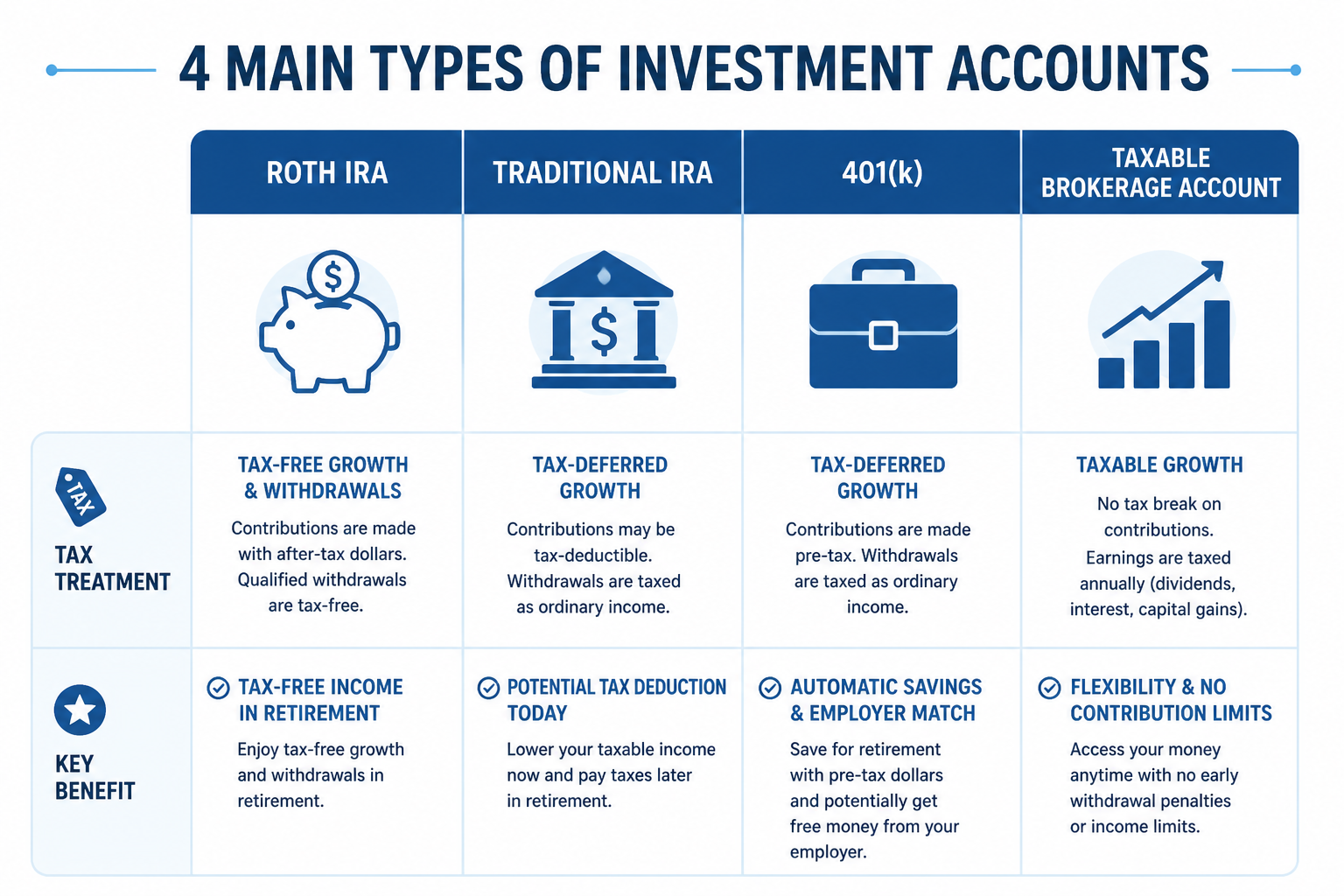
Before opening an account, you need to decide which type of account fits your goals. This decision has major long-term tax implications.
- Roth IRA: You contribute after-tax money, but all growth and qualified withdrawals in retirement are completely tax-free. For most people in their 20s and 30s, the Roth IRA is the single best retirement account available. The 2024 contribution limit is $7,000 per year ($8,000 if you are 50 or older). Income limits apply.
- Traditional IRA: Contributions may be tax-deductible now, reducing your current tax bill. Withdrawals in retirement are taxed as ordinary income. Better for people who expect to be in a lower tax bracket in retirement.
- 401(k): Employer-sponsored plan with a much higher contribution limit ($23,000 in 2024). If your employer offers a match, contribute at least enough to capture 100% of it — that is an immediate 50–100% return on your money.
- Taxable Brokerage Account: No contribution limits and no restrictions on withdrawals. You pay taxes on dividends and capital gains each year. Best for investing beyond retirement accounts or for financial goals within the next 5–10 years.
The standard recommended order is: (1) Contribute to your 401(k) up to the employer match. (2) Max out your Roth IRA. (3) If you have more to invest, go back and max out the 401(k). (4) Any excess goes into a taxable account.
Choosing Your First Investments
Start With Index Funds and ETFs
The most compelling investment strategy for beginners — and one that outperforms the majority of professional fund managers over 15+ years — is investing in broad, low-cost index funds or ETFs.
An index fund simply tracks a market index, like the S&P 500, by holding all (or most) of the stocks in that index in the same proportions. When you buy one share of the Vanguard S&P 500 ETF (VOO), you instantly own a tiny piece of all 500 companies in the S&P 500 — Apple, Microsoft, Amazon, Berkshire Hathaway, and 496 others. You get instant diversification across sectors, company sizes, and business models with a single purchase.
The biggest advantage of index funds over picking individual stocks is cost and performance. Actively managed funds charge expense ratios of 0.5%–1.5% annually — meaning they take $5–$15 from every $1,000 you invest each year. The best index funds charge as little as 0.03% ($0.30 per $1,000). And despite those higher fees, most actively managed funds underperform their benchmark index over time. You are literally paying more to get less.
Top beginner-friendly index funds and ETFs include:
- Vanguard S&P 500 ETF (VOO): 0.03% expense ratio; tracks the S&P 500
- iShares Core S&P 500 ETF (IVV): 0.03% expense ratio; also tracks the S&P 500
- Fidelity ZERO Total Market Index Fund (FZROX): 0.00% expense ratio; tracks the total U.S. stock market
- Vanguard Total Stock Market ETF (VTI): 0.03% expense ratio; covers nearly all investable U.S. stocks
Automate Contributions with Dollar-Cost Averaging
Once you have chosen your investments, automate your contributions. Dollar-cost averaging (DCA) means investing a fixed dollar amount on a regular schedule — say, $200 every month — regardless of whether the market is up or down. When prices are high, your $200 buys fewer shares. When prices drop, your $200 automatically buys more. Over time, this lowers your average cost per share compared to investing a lump sum at a single price point.
The deeper benefit of automation is behavioral: it removes the temptation to time the market and eliminates the anxiety of trying to find the "perfect" moment to invest. Set up automatic transfers from your checking account to your investment account on payday and you will build wealth in the background without constant decision-making.
How Much Should You Invest?
The oft-cited rule of thumb is to invest 10–15% of your gross income. But the right amount depends on your situation. If you carry high-interest credit card debt (above 8–10% APR), pay that off before investing aggressively — you cannot reliably earn more than 10% in the market while paying 20%+ on debt.
If you are starting small, even $50–$100 per month builds the habit and takes advantage of time. A 22-year-old investing $100/month at 8% average annual returns will have over $350,000 by age 65. Increase contributions as your income grows, and direct every raise, bonus, or tax refund toward your investments before lifestyle inflation can absorb it.
Understanding Risk and Return
Every investment involves a trade-off between risk and potential return. Higher potential returns generally come with higher short-term volatility and the risk of larger losses. Understanding this relationship helps you build a portfolio you can stick with through market downturns — which are inevitable.
Stocks are considered higher-risk, higher-return assets. The S&P 500 has fallen more than 20% in several bear markets (2000–2002, 2008–2009, 2020). But in every case, it has recovered and gone on to new highs. Investors who stayed the course were rewarded. Those who sold during panics locked in losses and missed the recovery.
Bonds are lower-risk, lower-return. U.S. Treasury bonds are backed by the full faith and credit of the U.S. government — they are essentially risk-free in terms of default. But they offer lower long-term returns than stocks. Adding bonds to your portfolio smooths out volatility at the cost of some long-term growth.
Your ideal allocation between stocks and bonds depends on two factors:
- Time horizon: The longer before you need the money, the more risk you can afford to take. A 25-year-old investing for retirement in 40 years can hold nearly 100% stocks. A 60-year-old nearing retirement needs more stability.
- Risk tolerance: How would you emotionally react if your portfolio dropped 30% in a year? If you would panic and sell, a more conservative allocation is better — even if it means lower expected returns. The worst thing you can do is sell at the bottom.
A common starting point for young investors is the "110 minus your age" rule: subtract your age from 110 and hold that percentage in stocks. A 30-year-old would hold 80% stocks and 20% bonds. This is a rough guideline, not a hard rule — many young investors hold 90–100% stocks given their long time horizons.
Common Beginner Mistakes to Avoid
The road to wealth through investing is littered with avoidable mistakes. Learn from the most common ones before they cost you real money:
- Trying to time the market: Academic research consistently shows that missing just the 10 best trading days in a decade cuts long-term returns nearly in half. Nobody reliably predicts market tops and bottoms. Stay invested.
- Panic selling during downturns: Market corrections — drops of 10% or more — happen on average once or twice per year. Bear markets (drops of 20% or more) happen every few years. Selling during a downturn locks in losses and means you miss the recovery. Time in the market beats timing the market, every time.
- Chasing hot stocks and trends: By the time a stock is featured on social media or financial news as a must-buy, much of the gain has already happened. Meme stocks, crypto fads, and "sure things" destroy far more wealth than they create for retail investors.
- Ignoring expense ratios: A 1% annual fee sounds trivial. But it can reduce your portfolio value by 25% over 30 years compared to a 0.03% fund charging the same portfolio. Always check the expense ratio before buying a fund.
- Not diversifying: Concentrating your portfolio in one stock, one sector, or one asset class is gambling, not investing. Even great companies can go bankrupt or stagnate for decades. Diversification through index funds is your protection.
- Investing money you might need soon: The market can drop 30–50% in a bear market and take years to recover. Only invest money you will not need for at least three to five years. Your emergency fund — three to six months of living expenses — should stay in a high-yield savings account, not the stock market.
- Waiting for the perfect moment: There is never a moment when investing feels perfectly safe. The best time to invest was yesterday; the second-best time is today. Markets are at all-time highs roughly 30% of the time — "waiting for a dip" often means waiting forever while the market runs higher.
Your 30-Day Action Plan
Knowing what to do and actually doing it are different things. Here is a concrete action plan to get you invested within 30 days:
- Week 1 — Open your account: Go to Fidelity, Schwab, or Vanguard and open a Roth IRA (if you have earned income and meet income limits) or a taxable brokerage account. It takes about 15 minutes online.
- Week 1 — Fund the account: Link your checking account and transfer an initial deposit. Even $100 is enough to start.
- Week 2 — Make your first investment: Buy shares of a total market or S&P 500 index fund. Use a market order to buy at the current price. Your first trade will feel anticlimactic — that is a sign you are doing it right.
- Week 2 — Set up automatic contributions: Schedule a recurring monthly transfer from your checking account to your investment account. Tie it to your payday so the money goes to investments before it can be spent.
- Week 3 — Check your 401(k): Log into your employer's retirement platform and confirm you are contributing at least enough to capture the full employer match. Increase your contribution rate by 1% if you are not already at the match level.
- Week 4 — Ignore the noise: Unfollow financial pundits predicting market crashes. Set a calendar reminder to check your portfolio quarterly — not daily. Resist the urge to make changes based on short-term market movements.
The investors who build the most wealth are not the ones who find the best stocks or time the market perfectly. They are the ones who start early, invest consistently, keep costs low, and stay the course through inevitable volatility. You now have everything you need to be one of them.
Frequently Asked Questions
How much money do I need to start investing in the stock market?
You can start investing with as little as $1 at most major brokers. Many platforms like Fidelity and Charles Schwab allow fractional share purchases, meaning you can buy a portion of expensive stocks like Amazon or Google for any dollar amount. There is no reason to wait until you have a large sum — starting small and investing consistently beats waiting to accumulate a bigger starting amount.
Is now a good time to start investing, or should I wait for the market to drop?
The best time to start is as soon as you have money to invest and no high-interest debt. Research consistently shows that waiting for a 'better price' leads to worse outcomes than investing immediately. Markets are at all-time highs roughly 30% of the time, and attempts to time the market statistically reduce returns for most investors. Time in the market beats timing the market.
What is the difference between a stock, an ETF, and an index fund?
A stock represents ownership in a single company. An index fund is a portfolio of many stocks designed to replicate the performance of a market index like the S&P 500. An ETF (Exchange-Traded Fund) is a type of fund that trades on an exchange like a stock — most index funds are available as ETFs. For beginners, a broad market index fund or ETF offers instant diversification and lower risk than picking individual stocks.
How long does it take to make money in the stock market?
The stock market is a long-term wealth-building tool. In any given year, the market can be up or down significantly. But over any 20-year period in the S&P 500's history, investors have come out ahead. Most financial advisors recommend investing only money you will not need for at least three to five years, and targeting a 10- to 30-year horizon for maximum wealth accumulation through compound growth.
Should I pay off debt before investing?
It depends on the interest rate. If you carry high-interest debt like credit cards (typically 18–25% APR), pay that off before investing — you cannot reliably earn more in the market than you are paying in interest. Student loans and mortgages at lower rates (under 6–7%) can be carried while investing, since market returns historically exceed those rates over the long run. Always capture the full 401(k) employer match first — that is an instant 50–100% return.