How to Build a Passive Income Portfolio from Scratch
A passive income portfolio is a collection of assets that generates regular income with minimal ongoing effort. This guide shows how to build one from nothing — combining dividend stocks, REITs, bonds, and other income streams into a cohesive strategy.
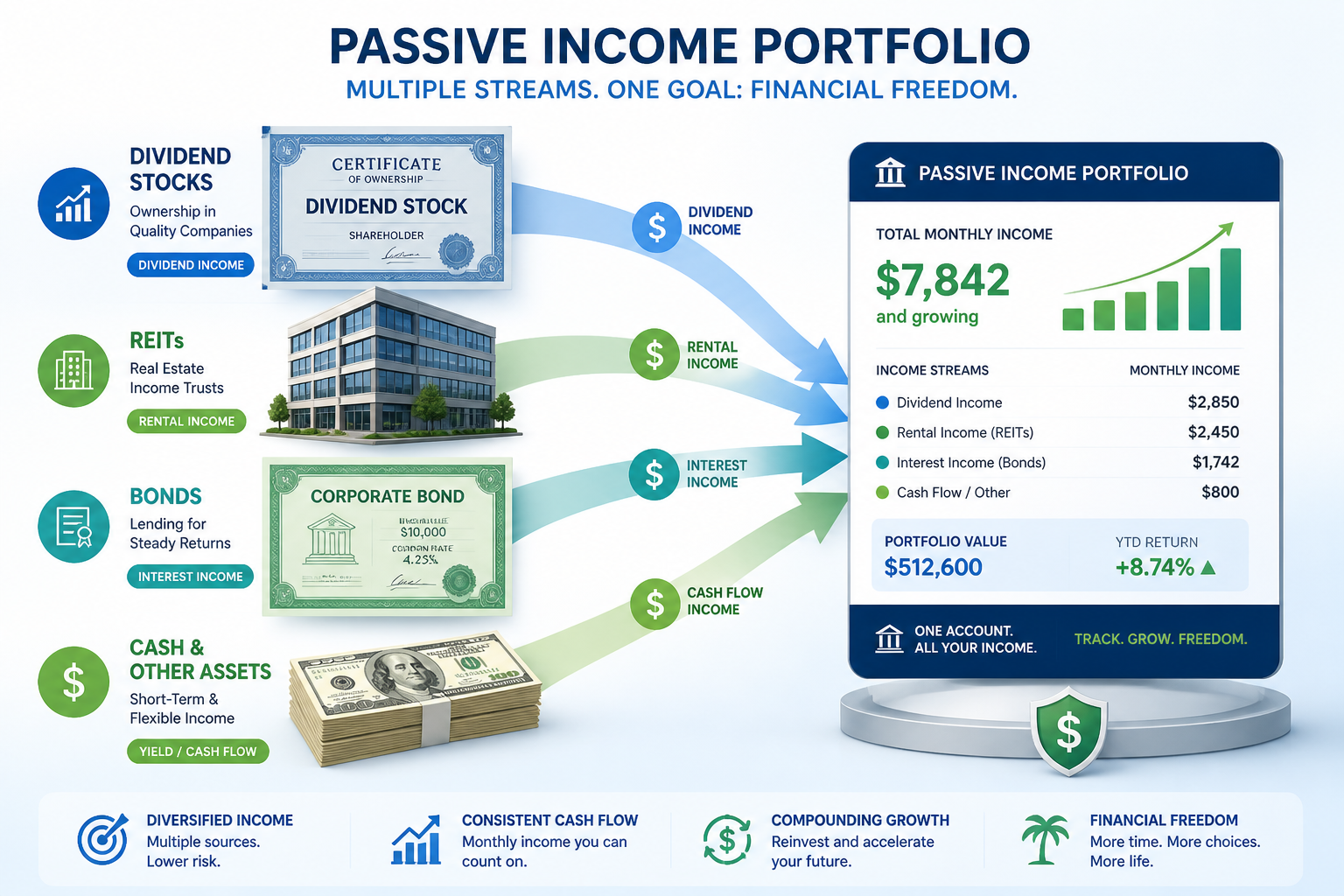
A passive income portfolio is not built overnight, and it is not a single asset class. It is a deliberate combination of income-generating investments — dividend stocks, REITs, bonds, and other cash-flowing assets — structured to produce regular cash distributions with minimal ongoing effort. When built thoughtfully, this portfolio becomes a financial engine that runs alongside your life, generating income whether you work that day or not.
This guide provides a complete framework for building such a portfolio from scratch: what assets to include, how much to allocate to each, how to sequence the building process as capital accumulates, and how to optimize the tax treatment of income across different account types.
Table of Contents
- What a Passive Income Portfolio Actually Is
- The Core Income-Generating Assets
- Building Your Allocation Framework
- Sequencing: How to Build It Over Time
- Setting Realistic Income Targets
- Tax Optimization for Income Investors
- Reinvestment vs. Withdrawal Strategy
- Sample Portfolio Constructions
What a Passive Income Portfolio Actually Is
Before designing a portfolio, it is important to be clear about what "passive" means in this context and what realistic expectations look like. Passive income from investments is income generated by assets you own — not by your active labor. Dividends from stocks arrive without you working for them. REIT distributions come from rents collected across properties you have never visited. Bond interest arrives on schedule from borrowers who owe it contractually.
However, "passive" does not mean effortless to build. Building a portfolio that generates $30,000 per year requires accumulating approximately $750,000 invested at 4% yield, or $1,000,000 at 3% yield. Getting there requires active saving, disciplined investing, and patience across years or decades. The passive part is what happens after the capital is deployed — not the journey of accumulating it.
A passive income portfolio is also distinct from a pure growth portfolio. Growth portfolios reinvest all returns to maximize terminal wealth; income portfolios prioritize current cash distribution. There is a trade-off: assets with higher current yields often grow more slowly, while assets with high growth potential tend to distribute less currently. The right balance depends on whether you need income now, soon, or eventually.
The Core Income-Generating Assets
Dividend Stocks and Dividend ETFs
Dividend-paying stocks distribute a portion of company earnings directly to shareholders, typically quarterly. Quality dividend payers — particularly Dividend Aristocrats (companies with 25+ consecutive years of dividend increases) — combine meaningful current income with growing payouts that keep pace with or exceed inflation over time.
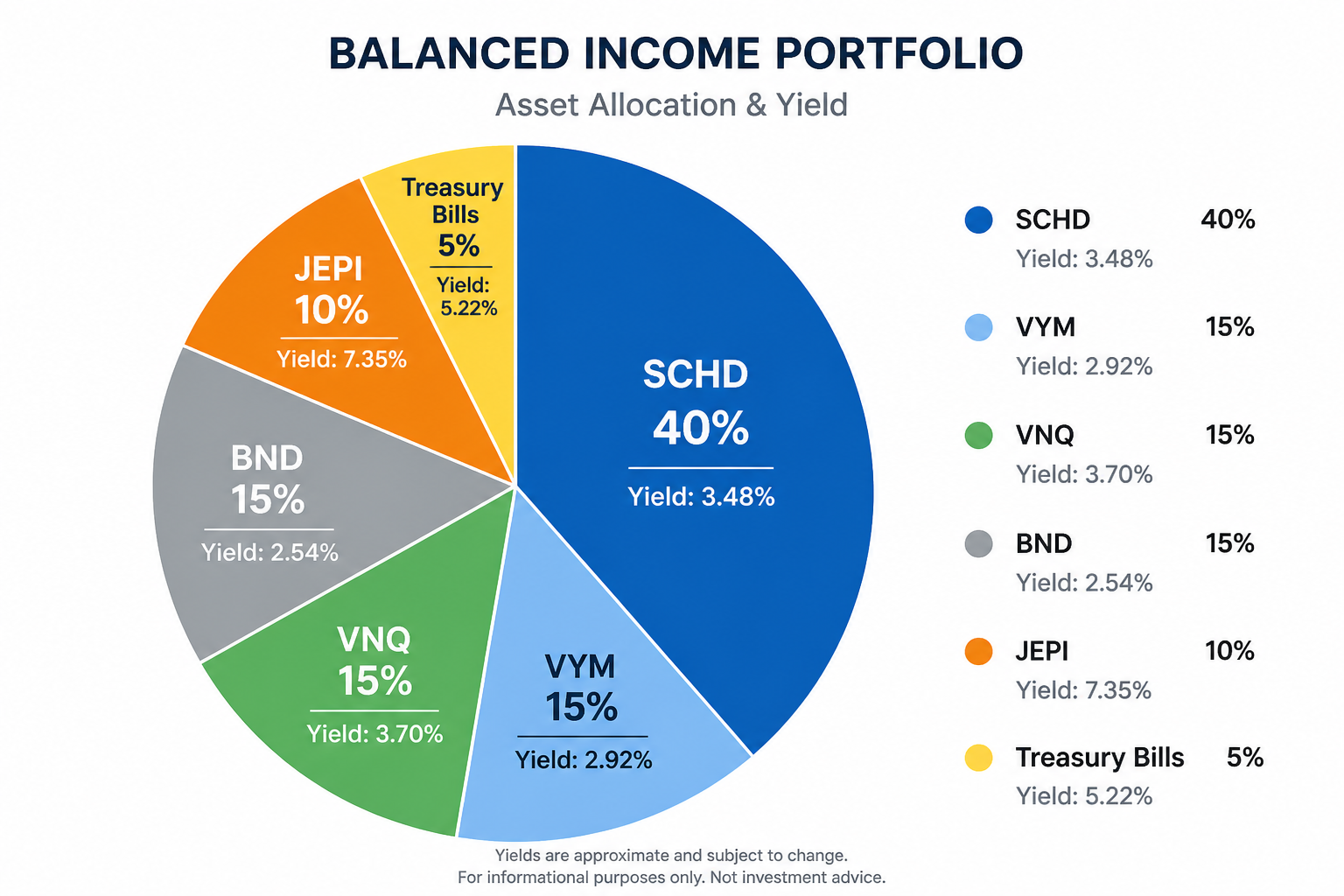
Dividend ETFs provide instant diversification across dozens of dividend payers. SCHD (Schwab U.S. Dividend Equity ETF, 0.06% expense ratio) is the most widely recommended for income-growth investors — its four-factor quality screen produces both solid current yield (around 3.5%) and strong dividend growth (historically 10–12% annually). VYM (Vanguard High Dividend Yield ETF, 0.06%) provides broader exposure with slightly higher current yield but slower growth. For maximum current yield, HDV (iShares Core High Dividend ETF) and JEPI (JPMorgan Equity Premium Income ETF) offer 4–9% yield with different risk trade-offs.
Real Estate Investment Trusts (REITs)
REITs are required by law to distribute at least 90% of taxable income as dividends, resulting in yields of 4–6% on average — significantly higher than most stock market dividends. VNQ (Vanguard Real Estate ETF, 0.12%) provides instant diversification across 160+ REITs covering every property sector. Individual REITs like Realty Income Corporation (O) — which has raised its monthly dividend for 25+ consecutive years — appeal to income investors who want direct property-type exposure and consistent monthly payments.
REITs distribute primarily as ordinary income (not the more favorable qualified dividend rate), making tax-advantaged accounts (Roth IRA, traditional IRA) significantly more efficient for REIT holdings than taxable accounts.
Bonds and Fixed Income
Investment-grade bonds provide contractual income — legally obligated coupon payments — rather than discretionary dividends. U.S. Treasury bonds (backed by the federal government) are the most secure; investment-grade corporate bonds offer higher yield in exchange for credit risk. The Vanguard Total Bond Market ETF (BND, 0.03%) provides comprehensive diversified bond exposure at minimal cost. For short-term income, Treasury bills (currently 4–5% annualized) provide government-backed returns with minimal duration risk.
High-Yield Savings and Money Market Funds
For the liquid, immediately accessible portion of your income portfolio, high-yield savings accounts (4–5% APY at leading online banks) and Treasury money market funds provide income without principal risk. These serve as the portfolio's cash-equivalent layer — not for long-term wealth building, but for income on capital you might need access to in the near term.
I Bonds and TIPS
Inflation-linked instruments provide income that adjusts with the Consumer Price Index. I Bonds (limited to $10,000/year per person through TreasuryDirect) and TIPS (Treasury Inflation-Protected Securities, available in unlimited amounts) ensure that income keeps pace with inflation — a crucial protection for long retirement horizons.
Building Your Allocation Framework
A passive income portfolio typically balances four objectives: current yield (income today), income growth (inflation protection over time), principal stability (not losing the base that generates income), and tax efficiency (maximizing after-tax income).
These objectives point toward different asset classes in different proportions. A portfolio optimized for maximum current yield (high REIT and bond allocation) may sacrifice income growth. A portfolio optimized for dividend growth (primarily SCHD and VIG) generates modest current income but doubles its income every 7–9 years. The right blend depends on your income timeline:
Accumulation phase (income not needed yet, 5–15+ years away): Emphasize dividend growth over current yield. SCHD and VIG as the equity core (70–80% of the income portfolio) alongside a modest REIT allocation (10–15%) and bond allocation for stability (10–15%). Reinvest all dividends. The portfolio compounds income at 8–10% annually, dramatically increasing the income generated when withdrawals begin.
Transition phase (income needed in 2–5 years): Begin increasing allocation to higher-current-yield assets. SCHD (core) + VYM (additional yield) + VNQ (REIT income) + BND (bond stability). Start taking a portion of dividends as cash rather than reinvesting 100%.
Income phase (drawing on income now): Higher allocation to current-yield assets. SCHD + JEPI (covered call ETF for enhanced income) + VNQ + BND + I Bonds + Treasury bills. Take all dividends and distributions as cash. Maintain DRIP only on dividend growth holdings held for very long future periods.
Sequencing: How to Build It Over Time
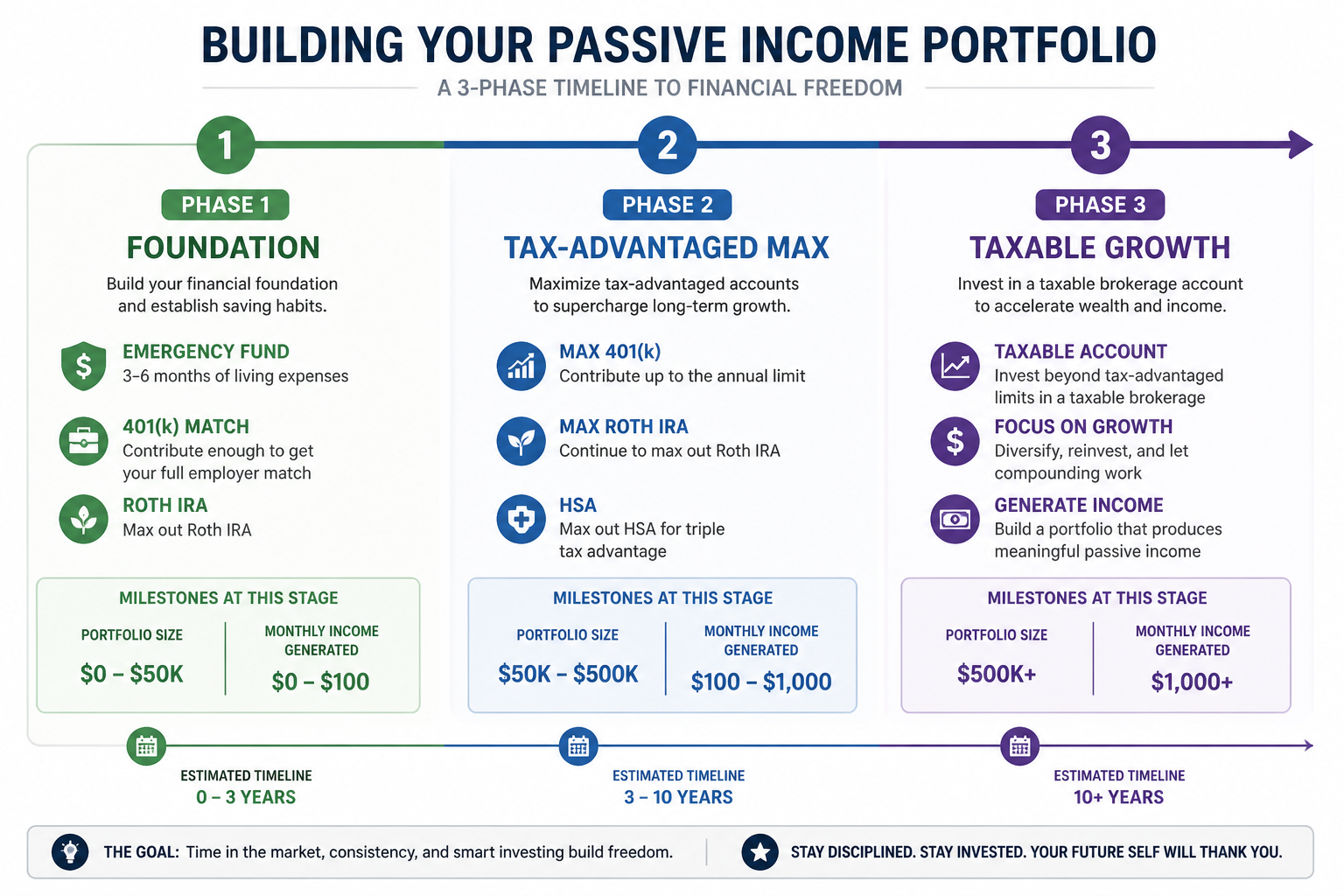
The sequencing of a passive income portfolio follows a specific priority order that maximizes wealth while minimizing tax inefficiency. This sequence assumes a typical earner without extremely unusual circumstances:
Phase 1 — Foundation (Year 1–2): Establish the tax-advantaged foundation before building taxable income streams. Contribute enough to your 401(k) to capture the full employer match (immediate 50–100% guaranteed return). Open and fund a Roth IRA — the tax-free compounding here is the most powerful component of long-term passive income. Build a 3–6 month emergency fund in a high-yield savings account. These steps take priority over any taxable income investing.
Phase 2 — Tax-Advantaged Maximization (Year 2–5): Maximize contributions to all available tax-advantaged accounts: Roth IRA ($7,000/year), 401(k) ($23,000/year), HSA ($4,150 single/$8,300 family). Inside these accounts, invest in dividend ETFs (SCHD, VYM) and REITs (VNQ) — assets whose income would otherwise be inefficiently taxed in a taxable account. All dividends reinvest tax-free. This phase builds the tax-efficient core of the income portfolio.
Phase 3 — Taxable Account Building (Year 5+): After maximizing tax-advantaged accounts, begin building in a taxable brokerage account. In the taxable account, prioritize tax-efficient income sources: Treasury securities (state tax-exempt interest), qualified dividend ETFs (taxed at preferential long-term capital gains rates), and broad index funds with low distributions. Less efficient income sources (REITs, covered call ETFs) stay inside tax-advantaged accounts from Phase 2.
Setting Realistic Income Targets
The most grounding exercise in passive income portfolio planning is working backward from your income goal to the portfolio size required:
| Annual Income Target | At 3% Yield | At 4% Yield | At 5% Yield |
|---|---|---|---|
| $12,000 ($1,000/month) | $400,000 | $300,000 | $240,000 |
| $24,000 ($2,000/month) | $800,000 | $600,000 | $480,000 |
| $36,000 ($3,000/month) | $1,200,000 | $900,000 | $720,000 |
| $60,000 ($5,000/month) | $2,000,000 | $1,500,000 | $1,200,000 |
These numbers assume you live off the income without touching the principal — a sustainable indefinite income approach. The 3% yield portfolio assumes dividend growth stocks like SCHD as the primary holding (lower current yield but growing payouts). The 4–5% yield portfolios include more REITs, covered call ETFs, and bonds to generate higher current income.
Building toward $1,000/month in passive income is a concrete, achievable milestone for many investors. Investing $400/month at a 7% total return for 20 years produces approximately $1,000/month in income from a $300,000 portfolio at 4% yield. This is attainable on a middle-class salary with consistent saving.
Tax Optimization for Income Investors
The difference between a tax-optimized and tax-unoptimized income portfolio can be worth thousands of dollars annually. Three principles govern tax-efficient income investing:
Asset location: Place high-yield, tax-inefficient assets (REITs, covered call ETFs, corporate bonds) in tax-advantaged accounts (Roth IRA, 401k). Place tax-efficient assets (qualified dividend ETFs, Treasury securities) in taxable accounts where their lower tax treatment is most favorable. This location optimization can add 0.5–1% annually to effective after-tax yield.
Account type matching: Roth IRA is ideal for REITs and covered call ETFs because their ordinary income distributions (which would be taxed at marginal rates in taxable accounts) compound and ultimately withdraw tax-free. Traditional IRA and 401(k) are best for high-yield assets where tax deferral is valuable. Taxable accounts are best for qualified dividend ETFs and Treasury securities where the tax treatment is already favorable.
Qualified dividends versus ordinary income: Qualified dividends from U.S. corporations held for the required period are taxed at long-term capital gains rates (0%, 15%, or 20%) — significantly lower than ordinary income rates (up to 37%). Most SCHD and VYM dividends are qualified. Most REIT dividends are ordinary income. This distinction drives the location decision: hold REITs in Roth IRA (tax-free) rather than taxable (ordinary income).
Reinvestment vs. Withdrawal Strategy
One of the most impactful decisions in income portfolio management is whether to reinvest dividends or take them as cash. The decision should be driven by your current income needs:
Reinvest when: You do not need the income for current living expenses. You are still in the accumulation phase. Reinvesting is the most powerful way to compound income — each dividend buys more shares, which pay more dividends, which buy more shares. Over 20 years, the difference between reinvesting and taking dividends as cash can more than double the final portfolio value.
Take as cash when: You need the income for living expenses, supplementing your primary income, or funding other goals. You are in the income phase and the portfolio has reached your target income level. Taking dividends as cash does not reduce the portfolio's income capacity — the shares remain, continuing to pay dividends. You simply choose not to compound further.
A common hybrid approach: reinvest dividends from growth-oriented holdings (SCHD, VIG) while taking distributions from high-yield holdings (VNQ, JEPI) as cash. This maintains compounding on the growth core while providing current cash flow from the high-yield satellite.
Sample Portfolio Constructions
Early-Stage Income Portfolio ($50,000 invested, 15+ years to income needed):
- 60% SCHD (dividend growth, 3.5% yield, 10%+ annual dividend growth)
- 20% VYM (broader dividend exposure, 3% yield)
- 10% VNQ (REIT income, held in Roth IRA)
- 10% BND (bond stability)
- Annual income at 3.2% blended yield: ~$1,600 (all reinvested)
Intermediate Income Portfolio ($250,000 invested, 5–10 years to income needed):
- 40% SCHD (core dividend growth)
- 20% VYM (higher current yield)
- 15% VNQ (REIT income, in tax-advantaged accounts)
- 15% BND (bond income and stability)
- 10% Treasury bills/I Bonds (safe current income)
- Annual income at 3.7% blended yield: ~$9,250 (partially withdrawn)
Active Income Portfolio ($500,000 invested, drawing income now):
- 30% SCHD (dividend growth core, income growing annually)
- 20% JEPI (covered call ETF, 7–9% yield for high current income)
- 15% VNQ (REIT income, in Roth IRA)
- 15% BND (bond income and stability)
- 10% VYM (broad dividend income)
- 10% Treasury bills/HYSA (liquid income reserve)
- Annual income at 4.8% blended yield: ~$24,000 ($2,000/month)
Building a passive income portfolio is a multi-year project, not a single decision. The investors who succeed are those who establish tax-advantaged foundations early, invest consistently, optimize account location as their portfolio grows, and gradually shift from reinvestment to income withdrawal as their financial situation evolves. Start with whatever capital you have, choose quality income-generating assets, automate contributions, and trust the compounding process. The portfolio that generates $2,000 per month was once a portfolio generating $50 per month — built one contribution at a time over years of consistent action.
Frequently Asked Questions
How much money do I need to start a passive income portfolio?
You can start with any amount — even $100 in SCHD or VNQ generates fractional income immediately. However, to generate meaningful income levels you need substantial capital: $300,000 generates approximately $1,000/month at a 4% average yield. Most people build toward this over 10–20 years through consistent monthly contributions while reinvesting dividends. Start with whatever you have and focus on the habit of consistent investing — the amount compounds from there.
What is the highest-yielding passive income investment?
Covered call ETFs like JEPI (7–9% yield), high-yield bond funds (5–8%), and some individual REITs (5–8%) offer the highest current yields among mainstream investments. However, higher yield usually comes with trade-offs: limited capital appreciation (covered call ETFs cap upside), credit risk (high-yield bonds), or interest rate sensitivity (long-term bonds and REITs). For most income portfolios, a blend of moderate-yield dividend growth ETFs (SCHD at 3.5%) and higher-yield assets (JEPI, VNQ) provides better long-term income sustainability than maximizing current yield alone.
How do I generate $2,000 per month in passive investment income?
At a 4% blended yield, you need approximately $600,000 invested in income-generating assets. At 5% yield (requiring more REITs and higher-yield bonds), you need $480,000. Building to $600,000 through monthly contributions of $1,000/month at 7% average return takes approximately 22 years. At $2,000/month contributions, it takes about 15 years. These timelines can be accelerated by increasing contributions with salary growth, maximizing tax-advantaged accounts, and choosing a portfolio weighted toward dividend growth that increases income annually.
Should I hold my passive income portfolio in a taxable account or IRA?
Both — the answer depends on the specific asset. Hold REITs and covered call ETFs (which generate ordinary income taxed at high rates) inside a Roth IRA or traditional IRA. Hold dividend growth ETFs like SCHD (qualified dividends taxed at favorable long-term capital gains rates) and Treasury securities (state tax-exempt) in taxable accounts where their tax treatment is already relatively favorable. This location strategy can meaningfully improve your after-tax income yield across the full portfolio without changing any of the underlying investments.